

The Hidden Cost of Running a Business Without a Plan
Missed opportunities, cash surprises and owner burnout rarely appear in the accounts but they may be among the biggest costs a growing business carry.
Quick Takeaways
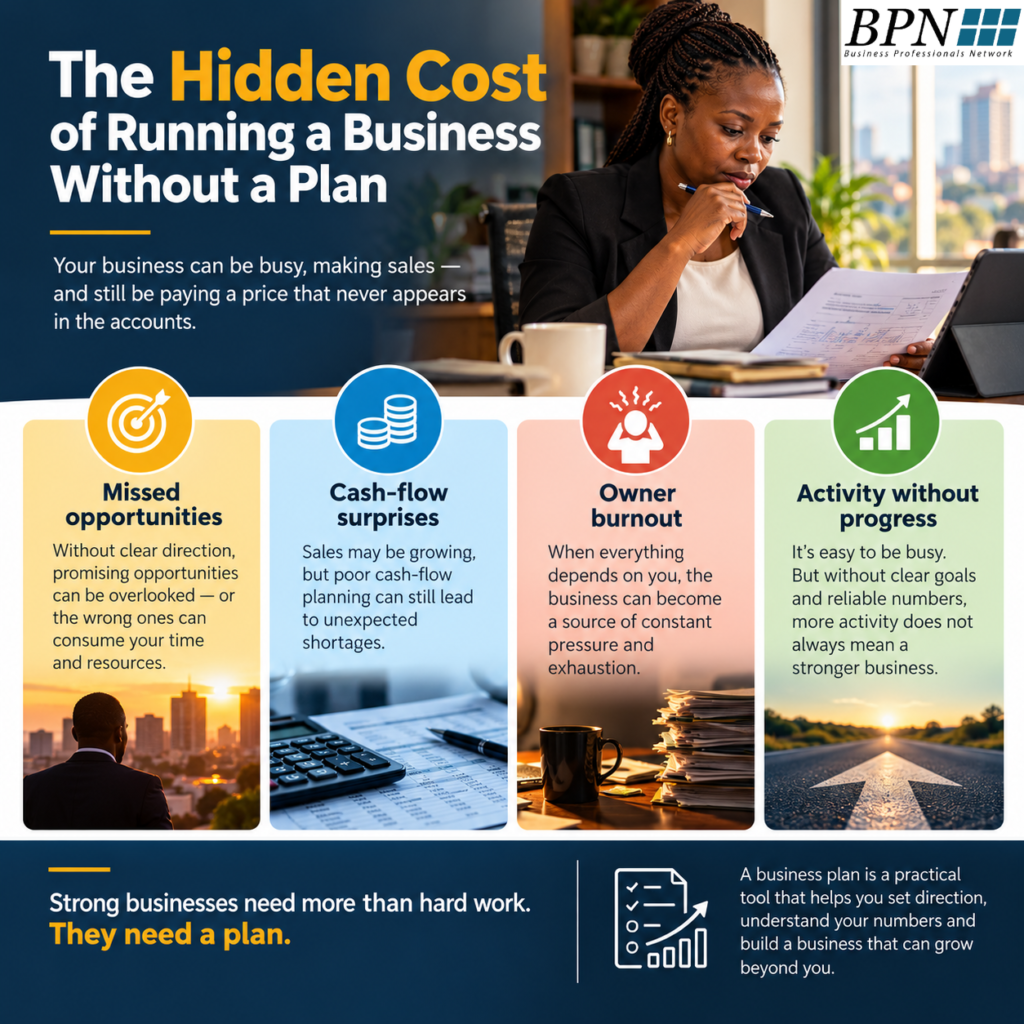
- Four hidden costs: poor planning costs Ugandan SMEs through missed or wrongly chosen opportunities, cash surprises, an overloaded owner, and busyness mistaken for growth. None of these appear in the accounts.
- Cash is about timing: profitable businesses often run short of cash because of timing, not lack of profit, so extra finance alone cannot fix a planning problem.
- Plans are tools: a useful business plan is a management tool, not a document for the bank.
- The BPN approach: BPN Uganda’s Business Development Programme supports SME owners through individual business coaching, practical Business Academy seminars and workshops, and the Business Owners’ Association, where entrepreneurs network and learn from one another.
Busy every day, but is your business moving forward?
It is 7:30 on a Monday morning and the phone is already ringing.
A supplier wants payment for last month’s delivery. A customer who promised to pay on Friday has not paid. One employee is absent. Another needs approval to purchase materials. Meanwhile, a potentially valuable client has requested a quotation by midday. Before lunch, the business owner has made perhaps twenty decisions.
By evening, he or she is exhausted. Money has come into the business and money has gone out. Customers have been served. Problems have been solved. The day has certainly been busy. But did the business move forward?
This is a question many entrepreneurs rarely have time to ask.
Uganda does not suffer from a shortage of entrepreneurial energy. According to Uganda’s Ministry of Trade, Industry and Cooperatives (2026), the country has approximately one million micro, small and medium enterprises (MSMEs), employing about 2.5 million people, equivalent to 90% of the non-farm private-sector workforce. The Ministry also identifies poor record-keeping and limited access to affordable credit among the sector’s challenges. These figures demonstrate the importance of MSMEs, but also why stronger business management matters.
We often discuss the businesses that fail. Perhaps we should also pay more attention to the businesses that survive but never become what they could have been.
Because running a business without a clear plan carries a cost. The difficulty is that this cost does not arrive with an invoice.
What Does Running a Business Without a Plan Really Cost?
Ask an entrepreneur about the cost of running a business and the answers are predictable: salaries, rent, fuel, electricity, taxes, raw materials, interest and transport.
These are visible costs. They are relatively easy to identify because somebody eventually asks you to pay them. But some of the most damaging business costs are invisible.
There is the customer you could have won but did not pursue. The machine purchased before the business was ready for it. The profitable product discontinued because nobody had properly analysed the numbers. The employee who could have taken greater responsibility but was never developed. The tender discovered two days before the deadline. The stock purchased with cash that was needed for salaries the following week.
Individually, such decisions may seem small. Over several years, they become expensive.
According to McKenzie and Woodruff (2017), a study of small firms across seven developing countries found that stronger marketing, stockkeeping, record-keeping and financial-planning practices were associated with better sales, profits and productivity. Longitudinal evidence also linked stronger practices with higher survival rates and faster sales growth. This is evidence of association, not proof that planning alone causes success.
The lesson is surprisingly simple: how a business is managed matters. And one of the first invisible costs of poor planning is opportunity.
The First Cost: Why Do Businesses Miss the Right Opportunities and Chase the Wrong Ones?
Ugandan entrepreneurs are constantly surrounded by opportunity. A friend suggests opening another branch. A customer asks for a new product. Someone knows a person who can supply goods from Dubai or China. A government tender is announced. A landlord has a good location available. A potential investor wants to talk.
The instinct of an ambitious entrepreneur is often to say: why not?
But opportunity without direction can become distraction. When a business does not know which customers it wants to serve, which products it wants to build around, and where it intends to be in three or five years, almost every opportunity appears attractive.
This creates two risks. The first is missing genuinely valuable opportunities because the business was not prepared. The second is perhaps more dangerous: pursuing the wrong opportunities and tying up scarce capital, people and management attention.
A useful business plan therefore does something entrepreneurs do not always associate with planning.
It gives you permission to say no.
A good opportunity is not simply one capable of generating revenue. It is one that takes the business closer to where it has decided to go.
The Second Cost: Why Do Profitable Businesses Run Out of Cash?
Few sentences create anxiety in a growing SME quite like: “We don’t have enough money in the account.”
What makes this particularly frustrating is that the same company may have customers. It may even be profitable on paper.
The problem is often timing. Customers have not paid. Too much money is sitting in stock. A large tax obligation is due. Loan repayments are approaching. A supplier requires advance payment. The owner has withdrawn cash without considering obligations coming later in the month.
This distinction between access to money and management of money deserves greater attention. Access to finance remains a genuine challenge for Ugandan enterprises; limited access to capital, alongside inadequate technical and business skills and regulatory constraints, is consistently identified among the barriers entrepreneurs face.
But finance alone cannot solve a planning problem. According to FSD Uganda’s MSE Recovery Fund Resilience and Survivability Report (2024), financial assistance is only one element of enterprise resilience. Businesses also benefit from stronger financial management, technical and business skills, diversification and innovation. FSD Uganda’s 2025 MSE Recovery Fund reporting similarly highlights the importance of business development support, reliable data and stronger systems alongside finance.
Put differently, additional capital injected into a poorly managed business may simply allow it to make bigger mistakes.
Planning forces an entrepreneur to look ahead. What will we sell next month? What will we collect? What must we pay? When will we need additional working capital? Can we afford this investment? The objective is not to predict the future perfectly. It is to reduce the number of times the future surprises you.
The Third Cost: What Happens When the Owner Becomes the Business?
There is another cost that does not appear in the financial statements.
It appears at 10pm when the entrepreneur is still answering WhatsApp messages. It appears during a family function when an employee calls because only the owner can approve a purchase. It appears when the entrepreneur tries to take a holiday but spends half of it solving problems back at the office.
Many businesses begin this way for understandable reasons. The founder sells. The founder buys. The founder recruits. The founder approves payments. The founder knows the important customers and remembers who owes what.
At five employees, this may work. At twenty employees, it becomes dangerous.
If every important decision must pass through the owner, the owner has not only built a business. He or she has also built a bottleneck.
This is where lack of planning gradually becomes burnout. The entrepreneur spends so much time working in the business that there is little time left to work on it. Employees also learn to wait rather than decide. Responsibility remains concentrated at the top. When something goes wrong, everybody asks: what does the boss say?
Growth then produces an uncomfortable paradox: the larger the company becomes, the less freedom its owner has.
Planning helps reverse this by forcing important questions. What should the owner still be responsible for? What should managers take over? Which processes should be documented? Which positions will the company require as it grows?
A business capable of growing sustainably eventually must become bigger than the person who founded it.
The Fourth Cost: Is Being Busy the Same as Growing?
Perhaps the most deceptive cost of all is busyness.
Ugandan entrepreneurs work extraordinarily hard. Many manage suppliers, employees, customers, regulators, banks and family obligations simultaneously. Hard work deserves respect. But hard work and progress are not always the same thing.
Sales can rise while profit falls. Customer numbers can increase while unpaid invoices increase faster. A company can open another branch while weakening its first one. Employees can work overtime while productivity declines.
Without clear goals and reliable numbers, activity can easily be mistaken for growth.
The practical question for an entrepreneur is therefore not simply “are we busy?” It is “are we becoming a stronger business?”
What Should a Useful Business Plan Look Like?
Unfortunately, the words business plan sometimes bring to mind a thick document prepared to obtain a bank loan, attract an investor, or satisfy a donor. Once its immediate purpose is fulfilled, the document disappears into a drawer.
That is not the kind of planning growing businesses need. A useful business plan is a management tool.
The BPN Uganda Approach to SME Development
At BPN Uganda, our work with entrepreneurs, through practical seminars, individual coaching, and an ongoing community of business owners emphasises critical analysis, defining priorities, and strengthening the areas where these four pillars show up: financial management, marketing, sales and employee management. The objective is not planning for the sake of producing paperwork. It is clarity that improves everyday decisions.
Every business owner should periodically be able to answer five questions, the same diagnostic questions at the heart of BPN’s coaching approach:
- Where do we want this business to be in three years? (Direction)
- Who are the customers and markets that will take us there? (Direction)
- Which numbers tell us whether we are making progress? (Numbers)
- What people and systems must we build so that everything does not depend on the owner? (Operations)
- What are the three most important things we must accomplish this year? (Discipline)
If those questions cannot be answered clearly, being extremely busy may simply mean travelling faster without knowing the destination.
Readers who want to see how planning strengthens financial management in practice may find our case study, Financial Management Training in Uganda: How a GM Turned Numbers Into Better Business Decisions, a useful next step.
The Most Expensive Cost May Be the One You Cannot See
Tomorrow morning, the phones will still ring. Customers will still negotiate. Suppliers will still want payment. Employees will still make mistakes. Unexpected opportunities will still emerge.
A business plan will not eliminate uncertainty. What it can do is provide a reference point against which decisions are made.
That matters because the real danger facing many SMEs is not necessarily dramatic failure. A business may continue operating for ten or fifteen years while quietly underperforming its potential. It may remain dependent on its founder. It may repeatedly struggle with cash. It may pursue one opportunity after another without building a defensible position.
And its owner may eventually conclude that this is simply what entrepreneurship feels like.
It does not have to be. For many Ugandan SMEs, therefore, the question is not simply whether the business can survive another year. The better question is: what will another year of operating without clear direction cost us?
That figure will probably never appear in the income statement. But it may be one of the largest expenses the business is paying.
Ready to find out what your business could look like with a clear plan behind it?
Explore the BPN Uganda Business Development Programme and learn how practical coaching can help you close these four gaps before they cost you another year.
Frequently Asked Questions
What are the hidden costs of running a business without a plan? The most significant are missed or poorly chosen opportunities, cash shortages that feel sudden but are usually predictable, an owner who becomes the business’s single point of failure as it grows, and constant busyness mistaken for progress. None of these appear directly in the accounts.
Why do businesses run out of cash even when they are profitable? Profitability on paper doesn’t guarantee cash in hand. Timing mismatches — unpaid customer invoices, tax obligations, loan repayments, or cash tied up in stock — are usually the real cause, not a lack of underlying profit.
How do I stop being the bottleneck in my own business? Start by identifying which decisions genuinely require the owner and which could be documented into a repeatable process or delegated to a manager. Planning — specifically around direction and operations — is what makes that shift possible.
What percentage of Ugandan SMEs fail within five years? Estimates vary by source, but according to Uganda’s Fourth National Development Plan (NDP IV), 2025/26–2029/30, over 60% of business enterprises do not survive beyond their first five years of operation. This highlights a significant challenge within Uganda’s entrepreneurial ecosystem: while many businesses are established, relatively few achieve sustained growth and long-term stability.
What should a small business plan include? A useful plan answers five questions: where the business should be in three years, which customers and markets will take it there, which numbers show progress, which people and systems remove dependence on the owner, and which three priorities matter most this year.
What is the BPN Uganda Business Development Programme? It is a Swiss-Ugandan programme that supports SME owners through practical seminars, individual business coaching and a community of entrepreneurs, built around four pillars: Direction, Numbers, Operations and Discipline.